
Toolkit: Real Skills for Real Life
February 05, 2026
A Public Education Promise Toolkit
Principle 2: The New Basics: Real Skills for Real Life
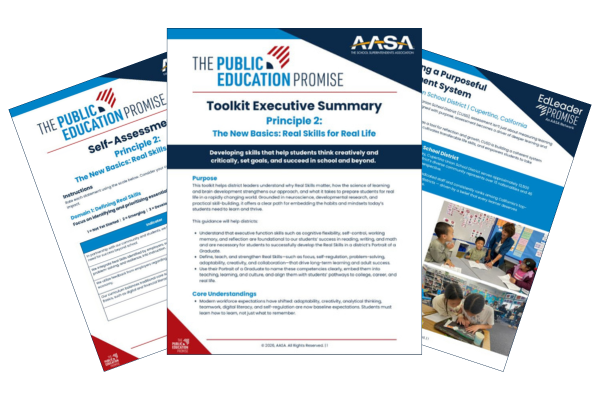
Developing skills that help students think creatively and critically, set goals, and succeed in school and beyond.
Real Skills for Real Life are not optional—they are the New Basics.
Districts that start early, embed these skills across learning environments, and stay aligned to what the brain needs to develop well-rounded, adaptable learners will prepare students for futures they cannot yet imagine.
When communities understand and value these skills, and educators have the tools to teach them, students graduate confident, capable, and ready for real life.
This Toolkit will Help District Leaders:
- Understand that executive function skills such as cognitive flexibility, self-control, working memory, and reflection are foundational to our students’ success in reading, writing, and math and are necessary for students to successfully develop the Real Skills in a district’s Portrait of a Graduate.
- Define, teach, and strengthen Real Skills—such as focus, self-regulation, problem-solving, adaptability, creativity, and collaboration—that drive long-term learning and adult success.
- Use their Portrait of a Graduate to name these competencies clearly, embed them into teaching, learning, and culture, and align them with students’ pathways to college, career, and real life.
Core Understandings:
- Modern workforce expectations have shifted: adaptability, creativity, analytical thinking, teamwork, digital literacy, and self-regulation are now baseline expectations. Students must learn how to learn, not just what to remember.
- The science of learning is unequivocal: executive function skills, healthy routines, play, exploration, and opportunities to practice real skills directly shape academic success and well-being now and in the future.
- When schools intentionally develop real skills and the environment and mindsets that support them, students gain agency and purpose—setting goals, managing challenges, and making informed decisions about their futures.
Toolkit Resources:
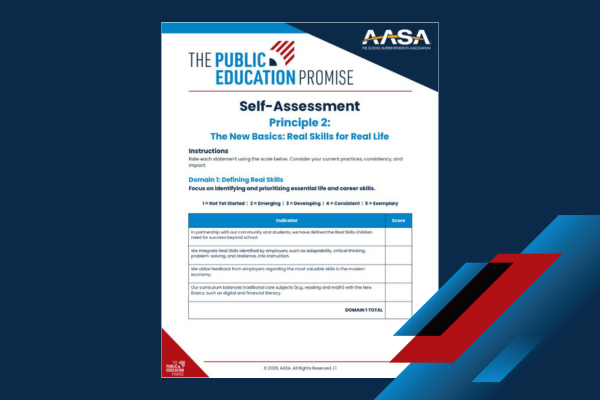
Self-Assessment
Real Skills for Real LifeUse this assessment to support reflection and leadership-level conversations around equipping students with real skills for real life.

Case Study & Companion Guide
Designing a Purposeful Assessment SystemIn California’s Cupertino Union School District (CUSD), assessment isn’t just about measuring learning—it’s part of it.
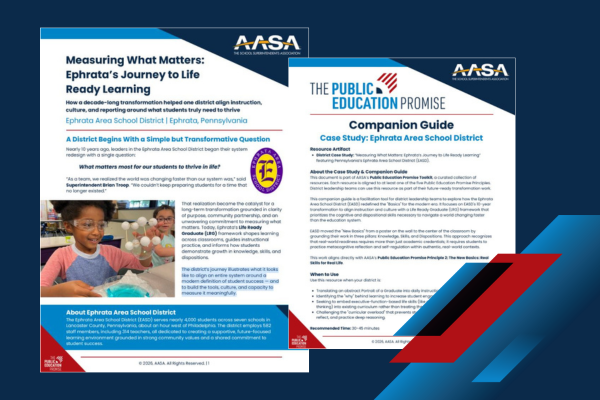
Case Study & Companion Guide
Ephrata's Journey to Life Ready LearningHow a decade-long transformation helped one district align instruction, culture, and reporting around what students truly need to thrive.

Critical Thinker Examples
Indicators & "I Can" StatementsThese examples can help districts move beyond rote content mastery and target the development of executive function skills
Thank you to our Principle 2: The New Basics - Real Skills for Real Life Work Group Members.
AASA Staff Leads:
- Shannon King
- John Malloy
- Beth Silveira
- Scott Wortman
Work Group Members:
- Jesse Bacon, Superintendent, Bullitt County Schools (Ky.)
- Michael Barnes, Superintendent, Mayfield City School District (Ohio)
- Gregg Behr, Executive Director, The Grable Foundation
- Amy Cashwell, Superintendent, Henrico County Public Schools (Va.)
- Gladys Cruz, Superintendent, Questar III BOCES (N.Y.)
- Richard Culatta, CEO, ISTE & ASCD
- John French, Superintendent, Lewis County C-1 (Mo.)
- Ellen Galinsky, President, Families and Work Institute
- Joe Gothard, Superintendent, Madison Metropolitan School District (Wis.)
- Stanley Harper, Superintendent, Salmon River Central Schools (N.Y.)
- Tim Hanson, Superintendent, MSD of Warren Township (Ind.)
- David Law, Superintendent, Minnetonka ISD 276 (Minn.)
- Angie Lewis, Executive Director, Savannah Chatham County Public Schools (Ga.)
- David Miyashiro, Superintendent, Cajon Valley Union School District (Calif.)
- Nick Polyak, Superintendent, Leyden Community High School District 212 (Ill.)
- Pam Quinones, Superintendent, Lovington School District (N.M.)
- Melissa Sadorf, Executive Director, Arizona Rural Schools Association
- Brian Troop, Superintendent, Ephrata Area School District (Pa.)
- Tom Vander Ark, CEO, Getting Smart
- Paula Wilkins, CAO, Winston-Salem/Forsyth County Schools (N.C.)
- Phil Zelazo, Professor, Institute of Child Development
About The Public Education Promise Toolkits
The AASA Public Education Promise Toolkits are designed to support district leaders as they move from vision to practice in ways that are locally meaningful, practical, and enduring.
Curated by AASA, in partnership with working groups comprised of superintendents, central office leaders, and education sector practitioners, the toolkits bring together real-world examples, reflection tools, and district artifacts aligned to each of the five Public Education Promise Principles.
What’s Inside the Toolkit?
The materials are intentionally practice-forward, recognizing that transformation looks different in every community and that effective change is led by those closest to the work. Within each principle, districts will find:
- Self-assessments to support reflection and conversation at the leadership team level.
- Case studies illustrating how districts are translating the Promise into action.
- District-developed artifacts and resources that surface how student-centered learning is defined, supported, and made visible across systems.
- Companion guides designed to facilitate discussion, make connections across initiatives, and support collective sense-making.
The toolkits are intended to be living resources. As districts continue to apply the Public Education Promise and share what they are learning, AASA will periodically add new case studies, tools, and resources to reflect emerging practice and deepen understanding of each principle.
View All Toolkits
Exclusive Access for EdLeader Promise Network Members
Want more actionable resources like this? Looking for a collaborative community committed to making the promise of public education a reality for every child?
AASA's EdLeader Promise Network members gain exclusive access to deeper resources, virtual learning, superintendent-only spaces, and more.
Advertisement
Advertisement



Advertisement
Advertisement