

Principle 1: Prioritize Student-Centered Learning

 Prioritize
Student-Centered Learning
Prioritize
Student-Centered Learning
Our children only get one chance at a K-12 education.
America’s public schools are entrusted with a profound responsibility: nurturing the unique potential of every young person.
Recognizing our students’ reliance on this period of time to prepare them for real life in the real world, we must ensure what is taught in school is fit-for-purpose and closely aligned with each student’s individual needs and strengths.
This goes beyond meeting basic needs or chasing rigid outcomes.
It’s about engaging students with meaningful learning opportunities—inside and outside the classroom—that ignite joy, curiosity, and confidence.
It’s about ensuring our public schools are places where every child in every community knows they belong, are valued, and have a voice.
It’s about prioritizing the New Basics that teach life skills such as problem-solving, self-reliance, resilience, and critical thinking alongside reading and math.
It’s about expanding on these skills and interests by providing experiences in the community through afterschool and summer programs, internships, externships, and service projects.
It’s about recognizing that a K-12 public education opens the doors to a huge world of possibilities.
For all children, building resilience through persistence and trial and error is foundational for success in the real world.
Ensuring that children are mentally fit and physically healthy is critical to developing a well-rounded child who leaves their K-12 education ready to excel at whatever they put their mind to.
Every child’s road to mastery of a task, skill, or subject differs. Whether through direct instruction, voice and choice, project-based learning, or something else, teachers and staff should work with students to co-create meaningful learning experiences in the classroom, on the field, in the cafeteria, and on the bus.
Giving students a voice so they can participate in their learning journey with increasing independence as they mature fosters a collaborative environment where students, teachers, parents, and communities shape public education experiences.
This requires a level of adaptability and a commitment to engaging young people in ongoing conversations about what they’re learning, what they are passionate about, what they need to be successful, what they hope for the future, and what barriers exist to achieving those goals.
In my experience, students come to life when schools combine academic excellence with a thoughtful, innovative approach to learning. Creating space for curiosity, voice, and growth shouldn’t be extra—it should be essential as we create programs that help every learner thrive in today’s world.
David Law, Superintendendent, Minnetonka Public Schools (Minn.)

Questions to Guide Practice on Prioritizing Student-Centered Learning:
What does the science of learning tell us about how students best develop the abilities they will need—life and professional skills—to succeed in the modern workplace?
How do we prepare students to be good citizens?
How do we ensure our students feel safe, supported, engaged, and have a true sense of belonging in our public schools?
How do we ensure students have the opportunity to apply the skills they are learning both inside and outside the classroom, through engaging productively with their local community, whether through sports, after school activities, the arts, or service projects?
How do local schools partner with communities to define what the Profile/Portrait of a Graduate looks like for their students?
How do teachers, parents, staff, and community members work together to ensure students build on their skills through experience, practice, and increasing autonomy as they work toward mastery? What does that developmental road to mastery look like in practice and curriculum?
How can modern technology support student learning to enhance their voice and autonomy?
How does the typical school day format work for today’s students, parents, and workforce readiness? Are there structural and system changes that need to be made to optimize learning?
What does “student-centered learning” look like, ideally, to students, and how do we measure self-efficacy and ensure students can make their own decisions?
Resources Supporting Principle 1
-
February 09, 2026
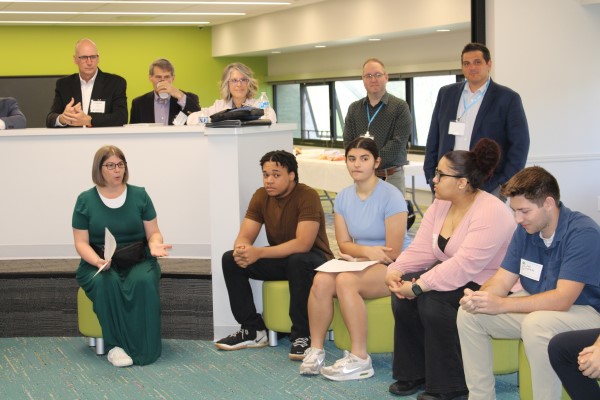
How Mayfield City Schools Is Redefining Student SuccessType:Case Study Topics: Curriculum & AssessmentWhen districts define success clearly and align their systems intentionally, they do more than respond to change. They lead it. -
February 05, 2026
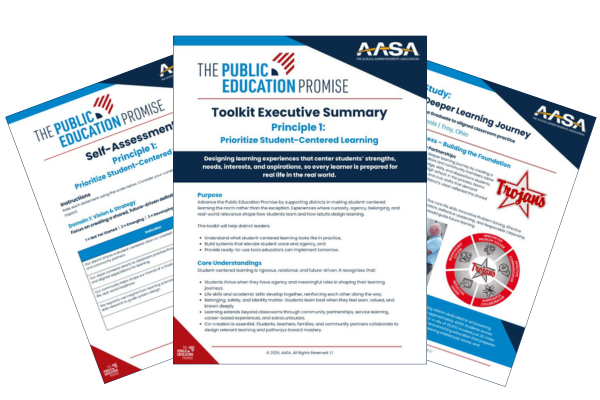
Toolkit: Prioritize Student-Centered LearningType:Toolkit Topics: Curriculum & Assessment, District & School OperationsResources to help school districts design learning experiences that center students’ strengths, needs, interests, and aspirations, so every learner is prepared for real life in the real world. -
February 05, 2026
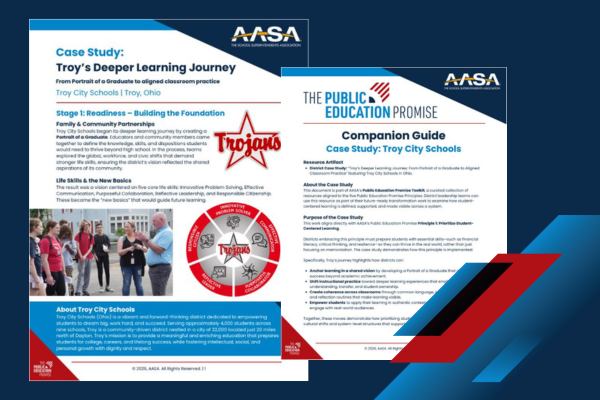
Case Study: Troy's Deeper Learning JourneyType:Case Study Topics: Curriculum & Assessment, District & School OperationsHow one district set the stage for developing shared practices that make student-centered learning visible in every classroom.
Join the EdLeader Promise Network
The Public Education Promise is more than a vision—it is a promise worth keeping for every community, every district, and every child we serve. AASA's EdLeader Promise Network is where courageous leaders come together to make the promise of public education a reality.