
It’s Time to Add a Fourth Tier to Your MTSS Model
April 21, 2026
Authors


Walk into almost any school in America right now and you’ll see it: counselors with packed schedules, students waiting weeks to see a therapist, and teachers doing their best to fill gaps they were never trained to fill.
The youth mental health crisis is real, it’s urgent, and the system we’ve been relying on to address it—the traditional three-tiered Multi-Tiered System of Supports (MTSS)—was simply not designed for this moment.
It’s time to build something better.
Why Three Tiers Is not Enough
The three-tiered MTSS model has long served as the backbone of school-based mental health support.
Tier 1 delivers universal social-emotional learning (SEL) programs for all students.
Tier 2 provides targeted supports like small-group counseling and check-in/check-out programs.
Tier 3 offers intensive, individualized services—IEP-based counseling or one-on-one support.
This framework is valuable. But when a student’s needs exceed what’s available in those three tiers, schools historically have turned to the pediatric mental health system—and that system is overwhelmed.
Recent surveys from the Child and Adolescent Mental Health Services and the Education Advisory Board (EAB)1 confirm what district leaders already feel in their bones: student mental health is the top concern.
The vast majority of principals identify accessing services as the most pressing issue, and nearly all superintendents agree that schools are best positioned to identify and respond to mental health concerns before a crisis develops.
Yet the National Center for Education Statistics2 reports that fewer than half of schools feel equipped to effectively provide mental health services—due to staff shortages, funding gaps, and limited access to qualified professionals.
We can do better. And here’s how.
Introducing The Fourth Tier
A fourth tier doesn’t replace what’s already working. It extends the framework by creating a formal bridge between school-based supports and the broader mental health system.
The Fourth Tier includes two important principles.
First, it represents a shift in ownership of student mental health supports whereby schools and districts coordinate or provide enhanced mental health support for students. Districts and schools transition to active coordinators of the full continuum of care a student might need. It’s about removing the barriers—transportation, long wait times, insurance navigation—that keep students from getting help.
Second, it includes specific services coordinated through districts.
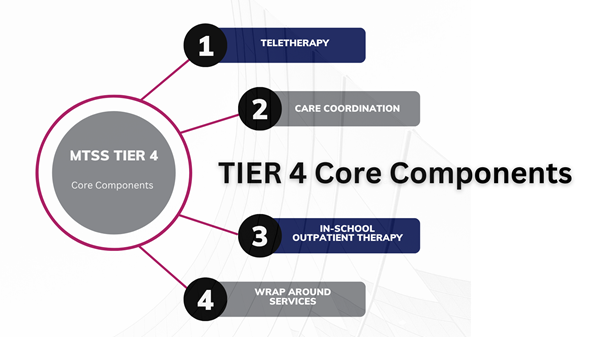
The five core components of a Tier 4 model include:
- Universal Mental Health Screening. You can’t support students you haven’t identified. Implementing a universal screening process—administered to all students at least once per year using validated tools—gives districts a data-driven foundation for the entire Tier 4 model. Screening normalizes mental health conversations, reduces stigma, and ensures that struggling students aren’t missed simply because they aren’t the ones raising their hands.
- Care Coordination. Without a dedicated coordinator, school counselors can spend entire weeks just trying to find providers that match a student’s needs, location, availability, and insurance. A dedicated care coordination function frees school counselors to do what they do best: directly support students.
- In-School Outpatient Counseling. Outpatient counselors from community mental health agencies meet with students during the school day. This eliminates transportation barriers and the after-school appointment bottleneck—benefiting both students and counselors who often have empty calendars during school hours.
- Teletherapy. Not every district can host an onsite outpatient counselor. Teletherapy closes that gap, giving students and families access to licensed therapists during or after the school day, from wherever they are.
- Wrap-Around Services. Family coaching, therapeutic mentoring, and mental health care team coordination have long been hallmarks of pediatric mental health care—but funding cuts have made them increasingly hard to access. Schools are uniquely positioned to deliver these services directly.
What the Research Tells Us
Districts that have implemented Tier 4 components report meaningful results: improved social-emotional competencies, reduced student suicidality, increased attendance, fewer behavioral incidents, and stronger academic performance.
Students are significantly more likely to complete treatment when care is provided in school—eliminating barriers is not just a logistical improvement, it’s a clinical one.
In addition, staff are more confident and less overwhelmed in supporting students with intense mental health needs.
By improving supports for the highest need students, you deal with a support bottleneck that exists and can improve programming across all tiers.
You Can Start Now - and It Doesn’t Have to Be Expensive
Here’s what surprises many district leaders: many Tier 4 components can be launched at little to no cost.
Partnerships with local mental health agencies, telehealth platforms, care coordination services, and community organizations already exist in most regions. What’s needed isn’t always more money—it’s intentional leadership and a willingness to expand how we define our role.
The three-tiered MTSS model gave us an essential foundation. But our students need more than a foundation right now. They need us to build on it.
As school leaders, we have both the opportunity and the responsibility to modernize our approach. The fourth tier has become a necessity.
1. EAB. 2023 voice of the superintendent: Key survey findings and crucial conversations for the year ahead. Accessed October 30, 2024. https://pages.eab.com/rs/732-GKV-655/images/EAB%202023%20Voice%20of%20the%20Superintendent%20Survey%20Brief.pdf
2. National Center for Educational Statistics. “Over Half of Public Schools Report Staffing and Funding Limit Their Efforts to Effectively Provide Mental Health Services to Students in Need.” May 9, 2024,https://nces.ed.gov/whatsnew/press_releases/5_9_2024.asp.
Subscribe to AASA's Blogs
Subscribe via RSS feed below. Learn more about RSS feeds here.
