The Burden of Stewardship
August 25, 2026
Author
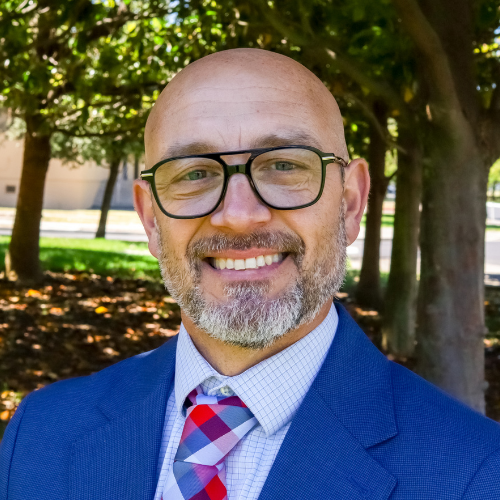
The Promise-Keeper blog series is part of AASA's 2026 "The Promise of Hope" back-to-school campaign, spotlighting AASA members who bring hope to life in their districts every day through courageous decisions, transparent leadership, and student-centered action.
The hardest question I have ever been asked as a superintendent didn't come from a trustee, a reporter, or a union leader.

It came from an eight-year-old child.
Standing at a microphone during a community meeting, the student looked directly at me and asked, "Why are you closing my school?"
For a brief moment, everything else disappeared. The budget projections. The enrollment charts. The spreadsheets. The board resolutions. None of those mattered. I wasn't speaking to a community anymore. I was speaking to a child whose world was about to change.
There wasn't an answer that could make the pain disappear.
So I told him the truth anyway.
I explained that the decision wasn't about him. It wasn't about his classmates or his teachers. They hadn't done anything wrong. Their school hadn't failed. The adults had a responsibility to make decisions for the health of an entire district, and sometimes those decisions affected wonderful schools filled with wonderful people.
I also told him something I believed with every fiber of my being: children should never have to carry the weight of adult decisions.
Leadership Is Experienced Through People
Leadership is never experienced through spreadsheets. It is experienced through people.
That moment has stayed with me because it reminds me that leadership is never experienced through spreadsheets. It is experienced through people. And yet, some of the most consequential decisions leaders make begin with numbers that eventually become deeply personal.
When I became superintendent of Vallejo City Unified School District, I inherited a district emerging from state receivership after years of fiscal instability. As we dug deeper into our finances, it became increasingly clear that the challenge wasn't a single mistake. It was a collection of systemic weaknesses that had accumulated over time.
We discovered an organization that had gradually become dependent on individual effort rather than reliable systems. There were gaps in fiscal controls, inconsistent position control, contracted services that lacked sufficient oversight, declining enrollment and student transfers that had not been fully addressed, and budgeting practices that no longer reflected the district's operational reality. Each issue, by itself, was manageable. Together, they revealed an uncomfortable truth: our greatest challenge wasn't simply the budget itself. It was that we could no longer trust the systems designed to tell us the truth.
That realization changed everything. What we initially believed would require modest adjustments became a comprehensive effort to rebuild the district's fiscal foundation.
When the Question Changes
My first reaction wasn't anger.
It was concern.
My first responsibility wasn't determining who was at fault. It was understanding why the organization had become vulnerable in the first place. Strong organizations don't rely on individuals to prevent failure—they rely on systems that make good decisions repeatable and mistakes visible before they become crises. Our work had to begin there.
Leadership required something different.
It required ownership.
Every leader eventually reaches the moment when the question changes. It stops being, "Who created this problem?" and becomes, "How do we move forward?" I didn't create the fiscal conditions facing our district, but the moment I accepted this role, I became responsible for solving them.
That responsibility meant having honest conversations before asking people to make difficult decisions.
Trust Before Tough Decisions

Before asking the governing board to make some of the hardest decisions of their public service, I met individually with every trustee. We sat down over lunch. We talked candidly about what we were learning, what remained uncertain, and why the information required us to rethink our path forward.
Those conversations weren't about persuading anyone. They were about building trust. People are far more willing to make difficult decisions when they believe they've been told the complete truth. Difficult decisions should never surprise people. They may disagree with the outcome, but they should never wonder how you arrived there.
As the financial picture became clearer, so did the reality that closing one school would not be enough. We had to begin talking about a broader strategy to right-size the district in the face of declining enrollment.
We intentionally referred to this work as "Phase One," because honesty required acknowledging that recovery would be a journey rather than a single decision.
Preserving Opportunity
One of the greatest misconceptions about school closures is that they are simply about saving money. Research suggests the financial benefits are often more modest than communities expect. For us, the larger purpose was ensuring that every remaining school had the resources, staffing, and collaborative capacity necessary to serve students well. Consolidation wasn't about reducing opportunity. It was about preserving opportunity by concentrating limited resources where they could have the greatest impact.
That distinction mattered.
Leaders create that hope by telling the truth, explaining the path, and walking it alongside the people they serve.
This was never about abandoning schools.
It was about strengthening a district.
Communities deserve leaders who explain not only what is changing, but why those changes are necessary.
Hope is not optimism.
Hope is confidence that there is a path forward.
Leaders create that hope by telling the truth, explaining the path, and walking it alongside the people they serve.
The Burden We Choose to Carry
I still think about that eight-year-old student.
I hope that one day he understands something I couldn't fully explain that evening.
Leadership isn't measured by how well we avoid difficult decisions. It's measured by whether we have the courage to make them with honesty, compassion, and integrity.
We are entrusted with more than budgets, buildings, or strategic plans.
We are entrusted with other people's futures.
That is the burden of stewardship.
It is a burden children should never have to carry.
It is one leaders must.