
The Current State of School Meal Programs
September 21, 2026
Findings from AASA's Survey on School Meal Programs
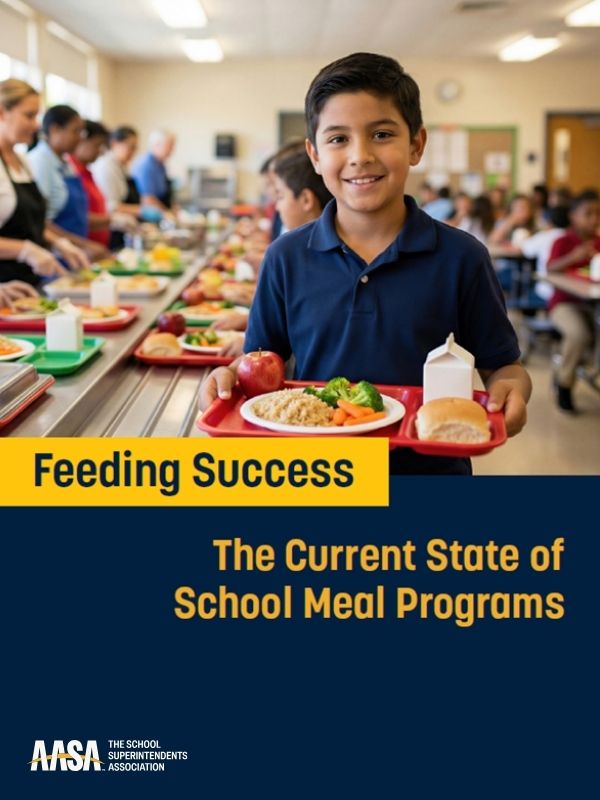
School meal programs ensure that every child is fed and ready to learn.
Serving roughly 46 million meals a day, these programs represent an important opportunity to provide critical nutrition for America’s children and help them build healthy habits for life.
Executive Summary
School meal programs play a critical role in supporting student health, well-being, and academic success. The findings in this report demonstrate that many districts are operating these programs under significant financial and operational constraints that limit their ability to serve healthy, appealing meals that align with the federal nutrition standards and expand practices like scratch cooking.
District leaders reported that insufficient reimbursement, staffing shortages, procurement challenges, limited kitchen capacity, and low student acceptance can make it difficult to operate financially sustainable programs. In some communities, districts are diverting resources from other educational priorities or drawing down reserves to continue serving meals.
Key Findings
- 67% of respondents indicated that current federal funding levels present a moderate or significant challenge for their school meal programs
- 40% of district leaders reported that last year they had to pull funding from elsewhere in their budget to cover the cost of their school meal programs
- When funding is excluded, the most commonly reported challenge facing school meal programs is compliance with federal nutrition standards (69%)
- In the context of the current federal nutrition regulations, 37% of respondents reported that student acceptance/ participation was the greatest operational challenge
- (44%) cited that every school in their district has a full kitchen equipped for scratch cooking
- The most commonly reported barriers to expanding scratch cooking are staffing (64%) and funding (61%)
For the last three consecutive years, our food service staff has been short by 3 employees. Due to funding, it is impossible to pay a competitive wage, let alone provide competitive benefits. Less staff equals more reliance on processed foods that can be heated and served. Until we are differently staffed, we can't think about making changes. Small, rural district in Wisconsin
Improving school meal programs and student health will require sustained financial investment and local flexibility to guarantee that every district is able to serve healthy foods that students enjoy. Without adequate federal support, districts face difficult budget decisions, including reducing funding for other priorities to absorb rising school meal costs or, in some cases, withdrawing from the federal school meals program altogether.
AASA looks forward to continuing our work with Congress and the Administration to ensure federal policy and funding reflects the operational realities of school meal programs, and district leaders are not forced to choose supporting children in the classroom and feeding them.
Download the report to access the full findings and recommendations.

Advertisement
Advertisement
.png?sfvrsn=2c854cfb_9)

Advertisement
Advertisement