House Subcommittee Advances FY27 Education Funding Proposal
June 05, 2026
Author

This morning, the House Appropriations Subcommittee on Labor, Health and Human Services, Education and Related Agencies advanced its Fiscal Year (FY) 2027 funding proposal. This funding would be available for districts in the 27-28 school year. While not as drastic as the prior year’s proposal, House Republican leadership, who wrote the bill without consulting Democrats on the Committee, once again propose significant cuts to most K-12 funding.
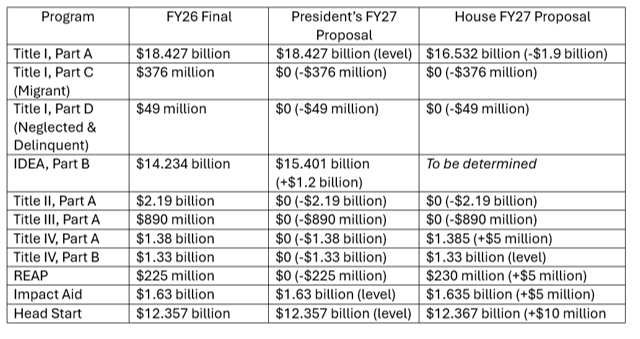
Overall, the proposal cuts $8.1 billion from the Department of Education (ED) – a 10% decrease from FY26 funding level. Most notably, it cuts Title I by $1.9 billion, about a 10% cut, and eliminates Title II, Part A (Supporting Effective Instruction) and Title III, Part A (English Language Acquisition). Like last year’s House proposal, the bill also rescinds $1.6 billion of Title II, Part A funding that was already appropriated as part of the FY26 funding bill – scheduled to go to districts this October. We are extremely disappointed to see the House’s continued efforts to claw back funds from districts that are already built into next school year’s budget.
IDEA, Part B received a $25 million increase and another $10 million for ED to provide technical assistance to States related to paperwork reduction challenges and opportunities, including support for States interested in pursuing the Paperwork Reduction Pilot waiver authority. Other increases include REAP (+5 million), Title IV, Part A (+5 million), Impact Aid (+5 million) and Charter Schools (+60 million). More information on other programs in the chart below.
Additionally, the proposal included a few policy provisions that would block federal funding from any institution with policies that allow staff to withhold student information from parents or allow transgender students to participate in girls athletics.
The proposal advanced through the subcommittee on party lines and a full committee markup is expected soon. However, even if this proposal moves through the House (which is still uncertain), it is extremely unlikely to get the Senate’s support. Any final spending bill will need some bipartisan support in the Senate to pass the filibuster and become law.
Subscribe to AASA's Blogs
Subscribe via RSS feed below. Learn more about RSS feeds here.