From Burnout to Balance: The Appreciation Jar as a System-Level Wellness Practice
January 13, 2026
Author

In my role as Assistant Superintendent for Student Services and Special Education, I spend a lot of time thinking about sustainability, not just for programs, but for people.
Because the work is demanding. We hold student stories that don’t leave us at 3:00. We absorb crisis, conflict, and grief. And then we’re expected to keep showing up with calm, clarity, and compassion, often with very little time to metabolize what our bodies just carried.
Lately, I’ve been asking leaders a simple question: What helped you last?
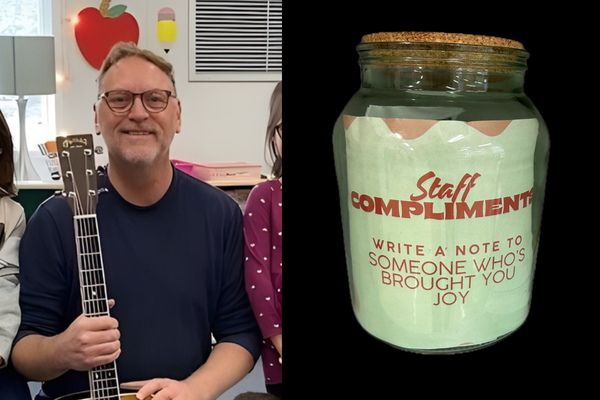
Recently, I asked that question of a principal retiring at the end of the year, someone known for steady, grounded leadership and for always finding the light at the end of the proverbial tunnel when the week felt heavy. I asked him because I had noticed something quietly powerful in the staff room: a plain jar, a pen, and a stack of slips.
Throughout the week, staff dropped in short notes of appreciation for one another. At the beginning of each staff meeting, he pulled a few notes at random and read them out loud.
We are rewarded for noticing what's not working and then fixing it. That mindset is necessary, but it also comes with a cost. When the only stories we tell are stories of urgency, the body starts to live there.
No big speeches. No forced positivity. Just specific, human moments.
I have attended a few of his staff meetings, and I could feel the shift in the room when he read those notes. Shoulders softened. People made eye contact. Someone would laugh, or tear up, or whisper, "That was mine." For a few minutes, you could see it: the nervous system exhale.
Here’s what struck me most: this wasn’t a "cute idea" or a feel-good add-on. It was a protective practice — a small, consistent ritual that countered what educators experience all week long: problem saturation.
In schools, we are trained to scan for needs. To find gaps. To identify risk. We are rewarded for noticing what's not working and then fixing it. That mindset is necessary, but it also comes with a cost. When the only stories we tell are stories of urgency, the body starts to live there.
The appreciation jar is one way to interrupt that conditioning, not by denying reality, but by widening it.
There’s a reason this works. Recognition builds belonging, and belonging is a buffer against burnout. Social connection is one of the most reliable protective factors we have against chronic stress. When people feel seen, specifically and sincerely, it doesn’t erase the hard things, but it changes how alone they feel carrying them.
When people feel seen, specifically and sincerely, it doesn’t erase the hard things, but it changes how alone they feel carrying them.
And that matters, especially in public education, roles that come with constant exposure to dysregulation, trauma histories, and high-stakes decision-making. Secondary traumatic stress doesn’t always show up as tears. Sometimes it shows up as irritability, numbness, fatigue, cynicism, or the quiet belief that your best will never be enough.
So I'm thinking about the jar as more than appreciation. I’m thinking about it as a system-level wellness move — a leadership behavior that says: We will not let the hardest moments be the only ones we name.
If you're a leader wondering what you can do that is realistic, affordable, and sustainable, consider this your invitation. You don’t need a new initiative. You need a ritual. Something simple enough to maintain and meaningful enough to matter.
Here are a few ways to make it work:
- Keep it specific. “You’re awesome” is nice, but “Thank you for stepping in during that lunch duty when I was overwhelmed” is regulating. Specificity makes it believable.
- Normalize small wins. Appreciation doesn’t have to be heroic. Sometimes the bravest thing a teacher does is return after a hard day and try again. Name that.
- Make it routine. Five minutes at a staff meeting. Two notes read aloud. Consistency is what turns a good idea into a protective system.
- Model it first. If leaders write notes, others follow. Culture is caught before it’s taught.
Pair it with "Name it to tame it." When someone is venting or activated, don’t rush them to gratitude. Start with: "That was a lot. What part felt biggest?" Then, once the nervous system settles, invite: "Was there anyone who helped you through it?"
This is not about pretending the work isn’t hard. It is hard. It is holy. And it is human.
And if we want sustainable schools, we have to build systems that don’t just manage outcomes — we have to build systems that protect the people doing the work.
The appreciation jar is a reminder that, even in our most demanding weeks, we still have moments of competence, care, humor, steadiness, and connection. Those moments don’t just feel good. They help our bodies recover. They help our teams stay.
And if we want sustainable schools, we have to build systems that don’t just manage outcomes — we have to build systems that protect the people doing the work.
Sometimes that starts with a jar. A pen. A small slip of paper. And a leader who refuses to let the light go unnamed.
Thank you, Principal Ron Kew, for your thoughtful leadership.
This post is part of an ongoing series exploring key strategies for preventing burnout and setting boundaries.
- Part I - From Burnout to Balance: Leading Schools Through Trauma
- Part II - From Burnout to Balance: Boundaries Without Guilt
- Part III - From Burnout to Balance: Building Cultures of Support
Leadership for Well-Being and Learning Summit
May 6 - 8, 2026 in Minnetonka, Minn.
When students and educators feel truly welcomed and able to be themselves, they thrive — and entire school communities benefit. Join AASA President David Law at the Leadership for Well-Being and Learning Summit to explore practical, proven strategies for building cultures of belonging, resilience, and meaningful staff support.