Communication Is Experienced, Not Announced
February 27, 2026
Author

As the Director of Communications and Policy for Edison Township Public Schools, I spend a great deal of time focused on how leadership is experienced by students, staff, and families. That perspective was reinforced this month while reading The New Superintendent as Communicator in Chief in the February issue of School Administrator. The article reflects a reality many districts are already navigating. Communication is no longer a supporting function of leadership. It is central to how leadership is understood, trusted, and evaluated.
Communication as a leadership competency ultimately depends on how leaders stay grounded in the lived experiences of the people they serve.
What stood out was not the call for greater visibility or more frequent messaging, but the quieter implication beneath it. The most effective leaders are not defined by how often they speak. They are defined by how thoughtfully they design systems that make listening visible, coherence possible, and trust sustainable over time.
Much of my recent writing in Schools of Thought has explored communication as infrastructure and reflective leadership. Systems, tools, and platforms can help leaders manage information and align messaging, but they are not sufficient on their own. Communication as a leadership competency ultimately depends on how leaders stay grounded in the lived experiences of the people they serve.
When Communication Begins With Students
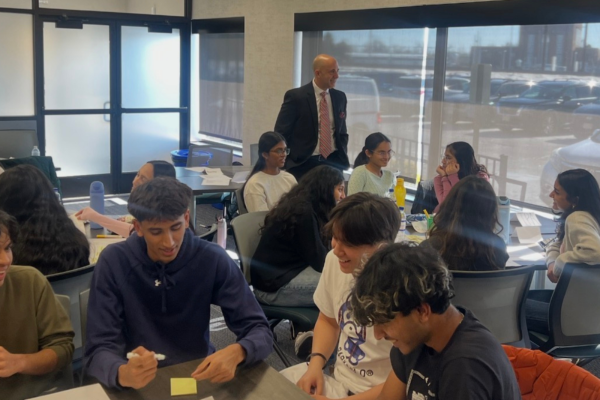
This week, we convened another in-person SAGES (Superintendent’s Advisory Group for Empowering Students) session, continuing work that began last year to create intentional spaces for student voice and shared leadership learning. From the outset, the goal was to create an inclusive and collaborative system where any student who wanted to engage in meaningful dialogue about their school experience could do so. For this session, students from our multiple high schools joined together for lunch and an afternoon to engage directly with our district’s Portrait of a Graduate strategic plan goals.
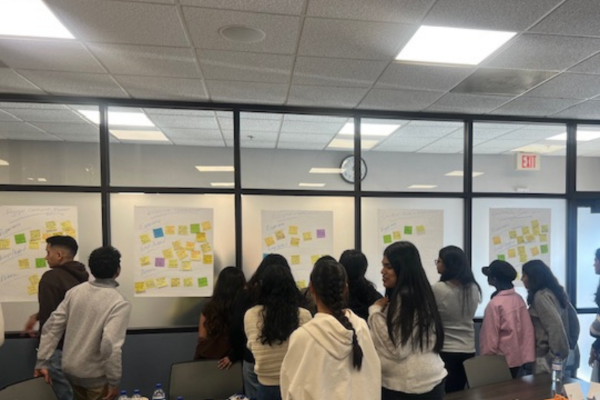
The structure of the session was deliberate. Students were not asked to multitask, present, or capture their thinking digitally. There were no devices in front of them. The focus was on conversation, reflection, and dialogue. By slowing the pace and removing the pressure to produce immediate outputs, we created space for students to speak freely and for Superintendent Dr. Aldarelli to listen and engage with care and attention.
Over the course of the session, students moved from reacting to language to shaping it. They questioned assumptions, clarified what graduate competencies look like in daily school life, and surfaced gaps between stated priorities and lived experience. What emerged was not a polished product, but shared understanding grounded in experience and meaning built together.
Communication as a Skill Students Practice, Not Just Receive
Through this work, students were not only reflecting on the Portrait of a Graduate, but learning how to articulate it. The conversations helped students practice listening, framing ideas, and communicating with purpose.
In shaping the Portrait together, students were also developing their own voice as communicators. Leadership was not teaching communication as a discrete skill. It was modeling it as a shared responsibility. In that way, communication became both the process and the outcome of the work.
The session culminated in students delivering “Portraits of Us” talks, which they will self-edit for sharing through district platforms, elevating authentic student voice.
What SAGES reinforces is that communication is ultimately a leadership judgment. Boards increasingly seek leaders who can make sense of complexity, communicate with steadiness when information is incomplete, and build trust over time. That work begins long before a message is drafted. It begins when leaders decide where listening occurs, whose voices are centered, and how feedback moves from conversation to action. When those decisions are intentional, communication is experienced as trustworthy rather than transactional.
This also reflects a core principle of The Public Education Promise. Students succeed when families, schools, and communities function as engaged partners rather than passive audiences. When communication invites participation, learning extends beyond the classroom and trust deepens across the community.
Listening Is Not a Phase
One of the most important ideas reinforced in current leadership conversations is that listening cannot be episodic. Entry plans and listening tours may open a leader’s tenure, but communication credibility is built through sustained practice.
Student advisory groups, family engagement structures, and community partnerships are not add-ons. They are leadership infrastructure. They ensure communication is relational rather than performative, grounded rather than reactive.
When leaders institutionalize listening, communication becomes steadier. Tension surfaces earlier, when it can still be addressed thoughtfully. Decision-making improves. Communities feel seen not because leaders are omnipresent, but because they are responsive.
What This Means for Leaders
For superintendents and leadership teams, the work is to communicate with purpose. In practice, that means:
- designing listening into leadership routines before messages are drafted;
- creating shared spaces where student, staff, and community voice informs decisions;
- aligning communication so lived experience and stated values match; and
- treating listening as an ongoing leadership responsibility, not a phase.
Through structures like SAGES, students know when their voices matter. This may be the most powerful form of communication leaders can build.