
2026 Winter Journal of Scholarship and Practice
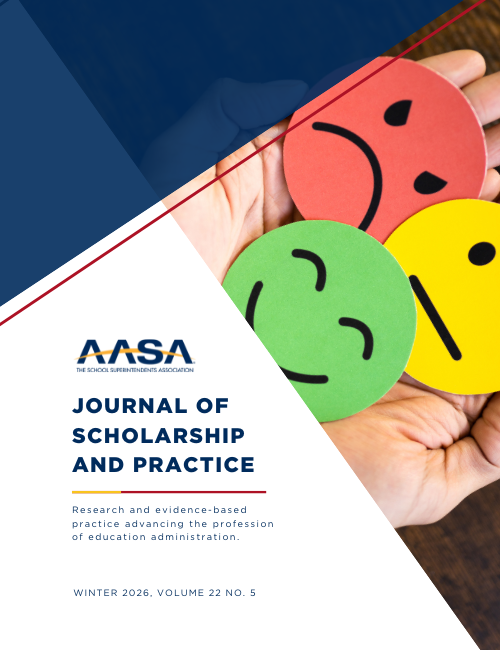
The Winter 2026 issue of the AASA Journal of Scholarship and Practice has been published on the AASA website and features three articles that in his editorial, Brian Osborne says “offer a sobering yet instructive portrait of educational leadership in contemporary K-12 systems.”
All three articles are research based with the first one titled “Are We Burned Out?” and written by Nicole Schilling, Kyle Wagner, Kristie Fetty, and Elizabeth Yoder. The study documents burnout among P-12 superintendents through a multi-year statewide study using the Copenhagen Burnout Inventory. The results of their research show that burnout is most acute in the form of emotional exhaustion and work-related fatigue. This study moves beyond acknowledging stress to specifying where burnout manifests, underscoring the cumulative toll of political pressures, crisis leadership, and constant availability.
“Contributing Factors to Secondary Administrator Job Satisfaction and Outcomes” is the title of the second research article and is written by Heidi Mickelsen and Rachel White. They focus on the day-to-day realities of secondary school administration. Using a mixed-methods study of vice principals, they highlight how inconsistent preparation, weak mentoring, irregular evaluation, and limited district support contribute directly to burnout and job dissatisfaction.
The final research article is titled “Female Superintendents and Complex Adaptive Systems Leadership.” It is written by Karika Ann Parker and provides a complementary look at female superintendents and complex adaptive systems leadership (CASL). Parker contends that traditional, hierarchical leadership models, still dominant in preparation programs, are ill-suited for volatile, uncertain, complex, and ambiguous environments, and too often rely on antiquated, patriarchal conceptions of leadership.
Says Osborne, “Across all three studies, a clear theme emerges: burnout is not simply an individual resilience issue but a systems and leadership design problem. The research consistently points to misalignment between job demands and available supports, whether at the superintendent, principal, or vice principal level.”
Additionally says Osborne, “Collectively these articles challenge the field to rethink how leaders are prepared, supported, and evaluated. They suggest that sustaining educational leadership will require not only attention to individual well-being, but also structural reforms that recognize complexity, promote shared responsibility, and align leadership practice with the realities of contemporary schooling.”
Advertisement
Additional Articles
-
 Are We Burned Out? A Multi-Year Statewide Study of P-12 Superintendents
This study examines an emerging theme of burnout among superintendents across the nation.
-
 Contributing Factors to Secondary Administrator Job Satisfaction and Outcomes
This study determines how preparation, mentorship, feedback, and district infrastructure influence secondary administrator principal job satisfaction and outcomes.
-
 Female Superintendents and Complex Adaptive Systems Leadership
This paper examines how female superintendents can apply complex adaptive systems leadership in a volatile and complex K-12 educational environment.
Thanks and Appreciation
The AASA Journal of Scholarship and Practice would like to thank AASA, The School Superintendents Association, and in particular AASA’s Leadership Network, and particularly AASA’s Leadership Network and Valerie Truesdale, for their ongoing sponsorship of the Journal. AASA Leadership Network, the School Superintendents Association’s professional learning arm, drives educational leaders’ success, innovation and growth, focused on student-centered, equity-focused, future-driven education.
We also offer special thanks to Brian Osborne, Lehigh University, with assistance from Kenneth Mitchell, Manhattanville University, in selecting the articles that comprise this professional education journal and lending sound editorial comments.
The unique relationship between research and practice is appreciated, recognizing the mutual benefit to those educators who conduct the research and seek out evidence-based practice and those educators whose responsibility is to carry out the mission of school districts in the education of children.
Without the support of AASA, Brian Osborne and Kenneth Mitchell, the AASA Journal of Scholarship and Practice would not be possible.
Interested in submitting an article? Learn more here
Additional Resources
- Read previous issues of the Journal of Scholarship and Practice
- Browse the latest resources on the all new AASA.org
- Access the latest advocacy updates on The Leading Edge Blog
- Read the latest issue of School Administrator magazine
- View upcoming AASA events and programs
Advertisement
Advertisement


