
The Leading Edge: Policy & Advocacy Blog
 The Leading Edge, AASA's policy & advocacy blog, provides up-to-date information about activities in Washington, D.C. and Capitol Hill that affect you and your school district.
Topics include new or proposed regulations and federal policies, federal funding updates and opportunities, advocacy resources and more.
Latest Posts
-

June 10, 2026
Treasury Outlines SGO Parameters Expected in RegulationsYesterday, the U.S. Department of Treasury held an event where they previewed forthcoming Treasury and IRS guidance for the implementation of the new federal scholarship tax credit program created in the One Big Beautiful Bill Act.
-

June 09, 2026
FCC Rulemaking Puts E-Rate at RiskLast Friday, the Federal Communications Commission (FCC) released a draft Notice of Proposed Rulemaking (NPRM) that raises serious concerns for the future of the E-Rate program.
-

June 09, 2026
U.S. District Court Blocks H-1B Visa FeeA U.S. district court has blocked the Trump Administration’s $100,000 fees for the H-1B visa program in a lawsuit that was filed by 20 state attorneys general.
-
June 09, 2026
AASA Urges House Appropriations Committee to Oppose FY27 Education Funding BillAhead of today's markup, AASA sent a letter to the House Appropriations Committee urging members to oppose the FY2027 Labor, Health and Human Services, Education and Related Services proposal that includes drastic cuts for K-12 education.
-

June 05, 2026
House Subcommittee Advances FY27 Education Funding ProposalThis morning, the House Appropriations Subcommittee on Labor, Health and Human Services, Education and Related Agencies advanced its Fiscal Year 2027 funding proposal.
-

June 03, 2026
Second Lady Usha Vance Introduces the 2026 Summer Reading ChallengeSecond Lady Usha Vance’s 2026 Summer Reading Challenge is officially live for your communities to participate.
-
June 02, 2026
AASA Sends Letter to Senate on 2026 Farm BillYesterday, AASA joined the Association of School Business Officials, International (ASBO) and the National Rural Education Association (NREA) in a letter to the Senate Committee on Agriculture, Forestry and Nutrition outlining our priorities for the 2026 Senate Farm Bill.
-

June 02, 2026
New Proposed OMB Rules Would Impact LEAsThe OMB has proposed new revisions to the Uniform Grants Guidance, which dictates the terms under which federal awards must be managed, as well as how and when they can be granted and rescinded. These changes will impact LEAs as well as many other recipients of federal funding.
-
May 29, 2026
DACA Renewals Are Delayed – What District Leaders Should KnowThe latest data indicates that about 20,000 educators across the country have work authorization through the DACA (Deferred Action for Childhood Arrivals) program. Current delays in renewals could impact school districts’ ability to maintain their staff.
-

May 27, 2026
Cross Post: How Rising Diesel Costs Are Squeezing District BudgetsThis blog post was co-written by AASA’s Noelle Ellerson Ng with ASBO’s Elleka Yost, another look at the organizations’ recent joint survey to gauge the impact of diesel costs on district budgets.
-

May 26, 2026
HHS Issues Proposed Rule to Rescind Head Start Wage RequirementsHHS has issued a proposed rule to eliminate requirements for increased wages and benefits for Head Start staff. These requirements were established in a 2024 regulation under the Biden Administration but did not go into effect until 2028 or later.
-

May 26, 2026
Surgeon General Issues Advisory on Screen TimeEarlier this week the U.S. Department of Health and Human Services (HHS) released a new advisory on children’s screen use.
-

May 21, 2026
New Department of Education Guidance Emphasize Local FlexibilityThe U.S. Department of Education (ED) issued two new “Dear Colleague” letters on Tuesday, emphasizing existing funding flexibility in Title V of the Elementary and Secondary Education Act (ESEA).
-

May 18, 2026
AASA Joins Coalition Letter on Cybersecurity and Infrastructure ProtectionAASA joined 14 other national education and technology associations in a letter to Capitol Hill.
-

May 18, 2026
Latest AASA Survey Looks at Impact of Rising Diesel Costs on District BudgetsEarlier this month, AASA partnered with the Association of School Business Officials International (ASBO) and National Association for Pupil Transportation (NAPT) to gauge how rising diesel costs are impacting school district budgets.


Latest Advocacy & Policy Resources
-
May 28, 2026
PEP Talk Episode 45: The FCC's New E-Rate Bidding PortalType:Podcast Topics: Advocacy & Policy, Finance & Budgets, Technology & AIOn this episode of PEP Talk: Kat Sturdevant catches up with Jon Bernstein and Joey Wender to talk about the FCC's new centralized E-Rate bidding portal for K-12 districts and what it means for school district leaders and technology officials. -
April 24, 2026
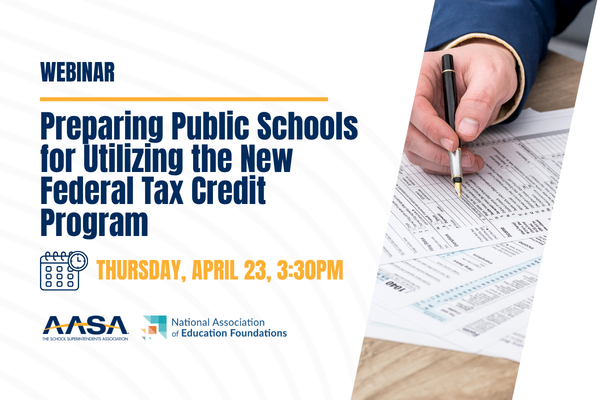
Preparing Public Schools for Utilizing the New Federal Tax Credit ProgramType:Webinar Recording Topics: Advocacy & Policy, Finance & BudgetsWebinar designed to help school district leadership navigate and leverage opportunities created by the federal tax credit scholarship program enacted as part of OBBB. -
April 17, 2026
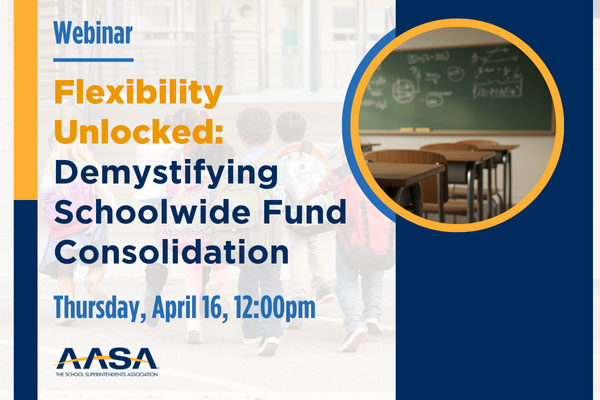
Flexibility Unlocked: Demystifying Schoolwide Fund ConsolidationType:Webinar Recording Topics: Advocacy & PolicyThis one-hour session broke down the statutory and regulatory framework for schoolwide fund consolidation, clarified what flexibility districts actually gain, and outlined practical steps to determine whether consolidation is right for your district.
Receive legislative and regulatory actions direct to your inbox
Stay updated on the issues that matter most to you and understand how they could affect you, your district, your students and your community.