Making Strategy Actionable: The Power of Plans and Scorecards
September 04, 2025
Author

What if your strategic plan wasn't just a destination on a map, but the driving force behind every turn? What if, instead of vague landmarks (like “take a right by the old K-Mart”), you had a clear roadmap for continuous improvement?
At Oxford School District, these questions sparked a journey that we’re still on. Join me as I share how "measuring what matters" became a guiding principle.
Aligning Strategic Plans with What Matters
One common criticism of public education is our reliance on standardized tests to measure student progress. However, beyond the numbers you typically see reported, there's often a richer story of growth and impact unfolding. Our strategic plan and scorecard have been the keys to understanding and sharing that complete picture with the people who are invested in us.
My goal when I became superintendent was to unite our school system. I wanted us to move beyond individual schools operating in isolation. Although we were already a high-performing district, I knew we lacked a shared direction. We needed to align our efforts. To achieve this, we had to rethink both what we measured and how we measured it.
Defining Success Beyond Test Scores
Test scores and graduation rates are important, but they don’t represent the whole student.
Test scores and graduation rates are important, but they don’t represent the whole student. In Oxford, we strive to make all students college, career, and life ready. But how will we know when we achieve that?
That's where we brought in teachers, parents, students, and the community. If we were going to measure what matters, first we had to agree on what matters. To ensure the validity of our measurements, we needed to collectively define this.
To gather that input, we conducted student, parent, and employee surveys, along with rounding. Gathering feedback was non-negotiable as we worked to get a full understanding of the things that were important to our stakeholders.
Moving Beyond Limitations
After gathering data, we rewrote our strategic plan. We recognized that while traditional plans outline broad goals and provide the high-level map, they often lack the detailed turn-by-turn directions and measurable objectives. This makes it difficult to track progress and truly know if
we’re on the right path. Additionally, traditional strategic plans often rely too heavily on state accountability models, leading to a narrow definition of success. This can cause us to overlook other critical aspects of student growth and well-being.
That’s why we needed an additional tool in Oxford: measurable indicators that would drive daily improvement, not just aspirational goals. We needed a scorecard.
The core purpose of these scorecards is to measure what matters most to us.
A Scorecard for Continuous Improvement
To increase alignment and reduce the feeling of fragmentation among our employees, we created district, department, and school-level scorecards. The core purpose of these scorecards is to measure what matters most to us.
Think of our scorecards as providing:
Our documented destination: Clearly stated goals.
Our current location: A snapshot of our present standing.
Our progress tracking: Monitoring our mileage and fuel consumption.
Our future route adjustments: Informing our plans ahead.
And because they’re aligned with the pillars of excellence in our strategic plan, every school and department works toward the same outcomes.
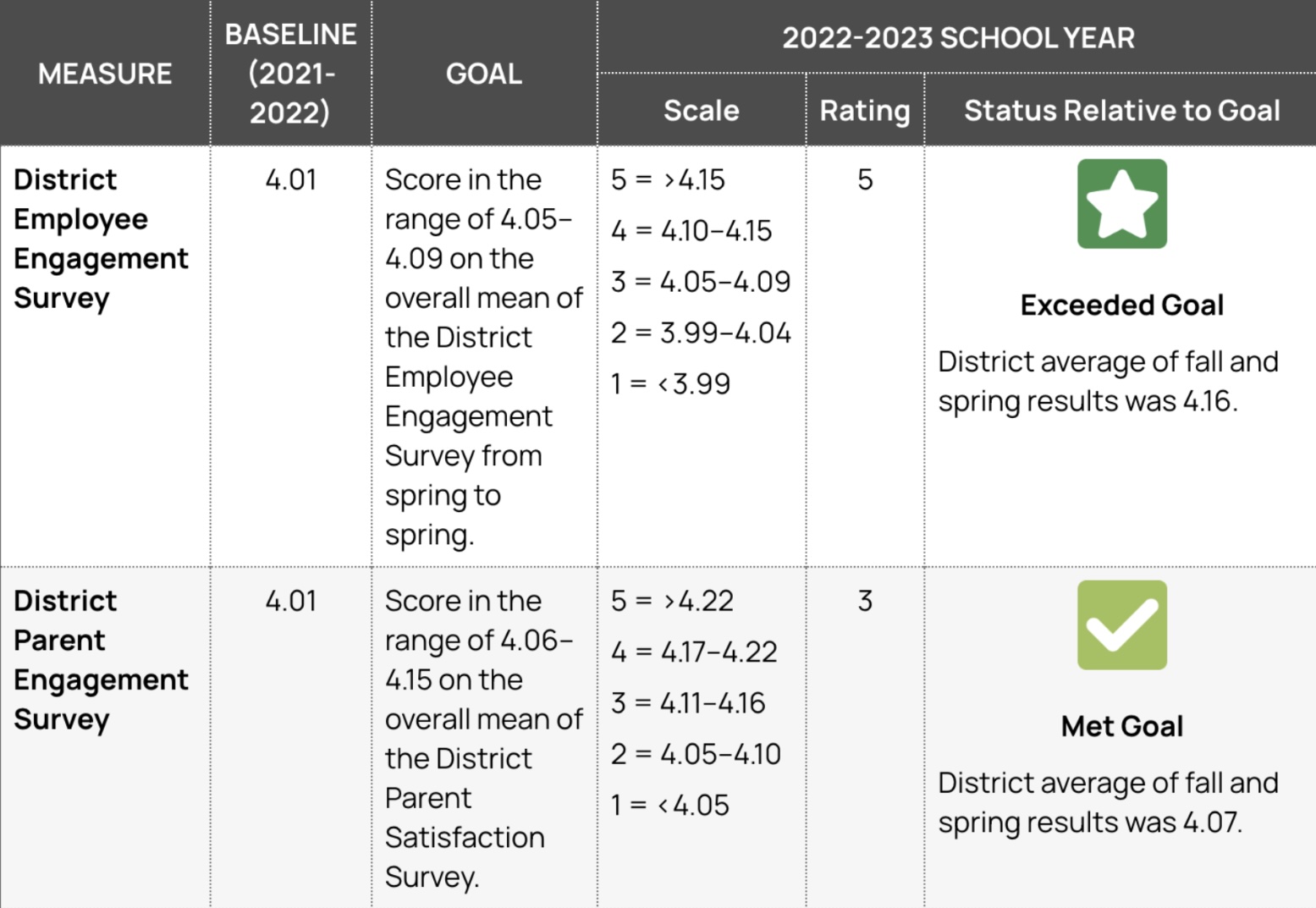
For example, here's a section of our district-wide scorecard related to our “culture” pillar. (You can actually see our full district-wide scorecard for the 2023-2024 school year here.
Notice how it includes the measure, baseline, goal, scale, rating, and status relative to the goal. Your goals will definitely be different than ours because your district has its own unique characteristics and needs, but I guarantee you’ll find some similarities with us, too.
Our Scorecard Results
Since implementing our scorecard, we've noted positive results in several areas, including:
Increased percentage of students that are high school ready
Increased percentage of students that are middle school ready
Increased percentage of students that are college, career, and life ready
Increased retention of high quality employees
Increased scores on employee engagement, parent, and district support services surveys
Looking Down the Road
Our strategic plan provides the overall goals and direction while the scorecard helps us measure, track, and report our progress toward those goals. Each day's actions, guided by these indicators in the scorecard, bring us closer to our end goals.
Every good road trip includes stops to rest, check the map, and make minor adjustments when unexpected detours arise (as they usually do). In my next blog, we’ll explore these essential "pit stops" – our short cycles of improvement – that make our scorecard a truly dynamic tool for building a culture of continuous improvement.
Subscribe to AASA's Blogs
Subscribe via RSS feed below. Learn more about RSS feeds here.