American Association of School Administrators
  • Home
  • About
  • Shop
  • Your Career
  • AASA Partners
  • Advertise
  • Newsroom
  • School Solutions
  • Policy & Advocacy
    • Educating the Total Child
    • Legislative Action Center
    • Public Policy Resources
    • The Leading Edge Blog
    • NREAC
  • Resources
    • School Safety Resources
    • Hurricane Sandy Relief Effort
    • School Administrator
    • AASA Blogs
    • AASA Multimedia
    • Books
    • College-Going Data
    • Publications
    • Research Papers
    • Technology Resources
    • Toolkits
    • Other Resources
  • Leadership Development
    • AASA National Superintendent Certification Program
    • Awards and Scholarships
    • Certified School Risk Managers (CSRM) Online Courses
    • Closing the Gap
    • Executive Consultant Program
    • LEAD District Learning Support Collaborative
    • Leadership Networks
    • New and Aspiring Superintendents
    • Professional Development Programs
    • State of the Superintendency
    • The Wallace Foundation
  • Events
    • Awards & Scholarships
    • Calendar
    • National Conference on Education
    • Networks/Consortia
    • Online Courses
    • Programs & Events
    • Virtual Seminars
  • Membership
    • AASA Membership Benefits
    • Become a Member
    • Membership Categories
    • Membership FAQ
  • Children's Programs
    • Healthy School Environments
    • Children’s Health Insurance
    • Competitive Foods
    • Coordinated School Health
    • Publications and Resources
    • Ready By 21
    • School Breakfast
    • Meet the Staff
    • Other Programs

Coordinated School Health

  • Coordinated School Health
  • Upcoming Health Observances
Featured Content

 AASA Connect

Ruler 


 1615 Duke Street, Alexandria, VA 22314, 703-528-0700 | info@aasa.org.

Log In

Don't have an account? Register
Forgot your password/member ID?

Enjoy the Benefits
of becoming a member

AASA is your advocate, with the resources you need to support all of your initiatives.

learn more
  • Email
  • Print
Home Page > Children's Programs

Coordinated School Health

COORDINATED SCHOOL HEALTH


The American Association of School Administrators (AASA) has received funding from the Centers for Disease Control and Prevention/Division of Adolescent and School Health (CDC/DASH) for Strengthening School Administrator Support for Coordinated School Health.

The American Association of School Administrators (AASA) has received funding from the Centers for Disease Control and Prevention/Division of Adolescent and School Health (CDC/DASH) for Strengthening School Administrator Support for Coordinated School Health.

• Why does AASA work on Coordinated School Health? Students that are healthy perform better in school.
• School leaders play an important role in putting policies and practices in place to insure that students are healthy and ready to learn.
• AASA has worked on children’s health issues for more than 30 years.

What are the project goals?

AASA is funded for five years (2011 – 2016) by CDC/DASH to build support among school administrators for Coordinated School Health. The goals of this five-year project are :

Goal 1: Increase the number of school administrators who promote a coordinated approach to school health at the national, state and local levels.

Goal 2: Increase the number of school districts and districts that have a group (e.g., school health team or council) that is actively engaged in guiding the development and implementation of health-related policies and activities.

Goal 3: Increase the number of school districts that have written school improvement plans that include health-related goals and objectives.

Goal 4: Increase the number of education administration programs in higher education that include instruction on a coordinated approach to students’ health.

In Year 1 of the project, we developed a strategic plan and logic model that will guide us through the next five years. We also conducted a survey of AASA members to learn more about what school districts are already doing to create a healthy school environment.

In Year 2 or the project, seven school administrators were trained to serve as cadre members.  This 2 and a half day training took place in July 2012 in Arlington Heights, IL.  After receiving the training, participants presented workshops to promote CSH at statewide conferences and meetings throughout the fall.  Cadre members also presented a workshop at NCE highlighting their achievements since the July training. 

A second cohort of cadre members is scheduled to be trained in July 2013.

What is Coordinated School Health (CSH)?

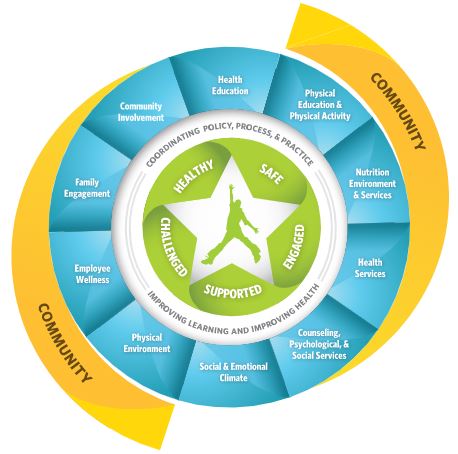
There are several definitions found in the literature or used by CDC, states, or local school districts to describe and promote CSH. There is no single best definition of CSH because programs must be tailored to meet each state's, school's, and community’s needs. The Center for Disease Control describes CSH as “a systematic approach to improving the health and well-being of all students so they can fully participate and be successful in school. The process involves bringing together school administrators, teachers, other staff, students, families, and community members to assess health needs; set priorities; and plan, implement, and evaluate all health-related activities. CSH typically integrates health promotion efforts across eight interrelated components that already exist to some extent in most schools. These components include health education, physical education, health services, nutrition services, counseling, psychological and social services, healthy and safe school environments, staff wellness, and family and community involvement.” (CDC. School Health Progress: Improving the Health of Our Nation's Youth—At A Glance 2010 [pdf 4.2MB], Atlanta: CDC; 2010.)

• The Institute of Medicine defines CSH as “A (comprehensive) school health program is an integrated set of planned, sequential, school-affiliated strategies, activities, and services designed to promote the optimal physical, emotional, social, and educational development of students. The program involves and is supportive of families and is determined by the local community based on community needs, resources, standards, and requirements. It is coordinated by a multidisciplinary team and accountable to the community for program quality and effectiveness.” (Institute of Medicine. Schools and Health: Our Nation’s Investment. Washington, DC: National Academy Press; 1997, pp 60-62.)

Resources

There are a number of coordinated school health resources available.  Here are a few that could be helpful:

What School Administrators Can Do to Enhance Student Learning by Supporting a Coordinated Approach to Health from the American School Health Association provides specific strategies for school administrators who have decided they want to support a coordinated approach to school health in their districts - http://www.ashaweb.org/files/public/Miscellaneous/Administrators_Coordinated_Approach_Support.pdf

Making the Connection II: Health and Student Achievement from the Society of State Leaders of Health and Physical Education is a useful tool to garner support for coordinated school health. This power point presentation clearly identifies how health and academic achievement are linked – www.thesociety.org/makingtheconnection

The Youth Risk Behavior Surveillance System (YRBSS) monitors six types of health-risk behaviors that contribute to the leading causes of death and disability among youth and adults. For YRBS information/statistics: http://www.cdc.gov/healthyyouth/yrbs/index.htm

The School Health Policies and Practices Study* (SHPPS) is a national survey periodically conducted to assess school health policies and practices at the state, district, school, and classroom levels, http://www.cdc.gov/healthyyouth/shpps/index.htm.

The School Health Profiles (Profiles) is a system of surveys assessing school health policies and practices in states, large urban school districts, territories, and tribal governments. Profiles surveys are conducted every 2 years by education and health agencies among middle and high school principals and lead health education teachers, http://www.cdc.gov/healthyyouth/profiles/index.htm.

To learn more about coordinated school health, go to http://www.cdc.gov/healthyyouth/cshp/index.htm

For more information about this project, Contact: Kayla Jackson, AASA Project Director, 703-875-0725 or kjackson@aasa.org.


May 2013


SCHOOL ADMINISTRATOR TRAINING CADRE

AASA is working closely with a cadre of school administrators from across the country who will serve as peer mentors to other administrators interested in incorporating coordinated school health into their school improvement planning process.  In late July cadre members met in Arlington Heights, IL, for two-and- a-half days of training to prepare them for this new role.  Please contact Kayla Jackson, Project Director, if you are interested in working on coordinated school health in your district.

The School Administrator Training Cadre member are as follows:

Sarah Jerome, Superintendentd, Arlington Heights School District 25, IL

Richard Lyons, Superintendent, Maine School Administrative District #22, ME

Nancy Tondre DeFord, Superintendent, Park City School District, UT (Retired)

Michele Hancock, Superintendent, Kenosha Unified School District, WI

James Hodgkin, Superintendent, RSU #4, Wales, ME

Nimisha B. Kumar, Prinicipal, Orlando Park, IL

Betty Womack, Asst. Supt. of Student Services (Retired), Houston, TX

John Skretta, Superintendent, Norris School District, NE

Deb Wilson, Superintendent, Prospect Heights School District 23, IL

New CP Logo


Advertisement
  • © 2013 AASA
  • Contact Us
  • Site Map
  • Legal Disclaimers
  • 1615 Duke Street, Alexandria, VA 22314; 703-528-0700 | info@aasa.org