
The Leading Edge: Policy & Advocacy Blog
 The Leading Edge, AASA's policy & advocacy blog, provides up-to-date information about activities in Washington, D.C. and Capitol Hill that affect you and your school district.
Topics include new or proposed regulations and federal policies, federal funding updates and opportunities, advocacy resources and more.
Latest Posts
-

April 16, 2024
Making the Most of Your Summer Fun(ds)—Creating Connections with Students and FamiliesThis is the eleventh installment of the Summer Funds series with AASA President Gladys Cruz.
-

April 16, 2024
AASA Joins National Organizations Endorsing COPPA 2.0AASA is pleased to endorse COPPA 2.0, as introduced by Senator Markey and others.
-

April 15, 2024
AASA Co-Hosts School Safety Briefing on Capitol HillOn Thursday, AASA was proud to co-sponsor “Smart School Safety: How Schools and Congress Can Maximize Investments for Kids” along with Sandy Hook Promise and the National Association of School Psychologists.
-

April 15, 2024
FAFSA Office HoursAs part of the FAFSA Week of Action (April 15 - 19), USED invites you to join USED staff for an office hours session for counselors, principals, school administrators, and school board members.
-

April 10, 2024
EPA Issues National Primary Drinking Water RegulationToday, the Biden Administration released a final National Primary Drinking Water Regulation for six PFAS – the first ever enforceable limit of so-called “forever chemicals”. This rule will directly impact districts that operate a non-transient, non-community water system (NTNCWS).
-

April 10, 2024
K12 Cyber and You: Ready to Go ResourcesWe have a list of resources from the Cybersecurity and Infrastructure Security Agency (CISA) in the Department of Homeland Security.
-

April 09, 2024
Community Sign-On Letter for Increased Labor-HHS-Education Funding in FY 2025The Committee for Education Funding is circulating their annual sign-on letter to secure a strong funding allocation for the House and Senate Labor-HHS-Education Appropriations Subcommittees.
-

April 05, 2024
ED and DOL Announce Additional Actions to Support Pathways Into EducationThis week, the Department of Education and Department of Labor announced actions to further expand access to high-quality and affordable pathways into education professions, including residency, grow your own, and Registered Apprenticeship programs. These actions include new funding and technical assistance.
-

April 04, 2024
The Advocate April 2024: What To Expect for FY 2025 AppropriationsNow that Congress has finalized Fiscal Year (FY) 2024 funding (see the full breakdown of that package here) – it’s time to immediately pivot to FY25.
-

April 02, 2024
USED Releases Guidance on Federal Property InterestLast week, ED issued guidance regarding the government-wide recording and reporting requirements for ESSER projects related to the acquisition or improvement of facilities with federal funds.
-

March 28, 2024
Making the Most of Your Summer Fun(ds)— Preparing Educators for a Great SummerThis is the tenth installment of the Summer Funds series with AASA President Gladys Cruz.
-

March 25, 2024
It’s Time We Talk About FAFSAThis blog post ran as an email from AASA Executive Director David R. Schuler to all members, and is cross-posted here so we can disseminate on social media and elsewhere.
-

March 22, 2024
AASA-Led Legislation Introduced to Bolster Student Mental Health Services NationwideOn March 21st, Sens. John Cornyn, Thom Tillis, Maggie Hassan, Jon Tester and Kyrsten Sinema, introduced the “Creating Access and Resources in Education (CARE) for Student Mental Health Act.”
-

March 22, 2024
FY24 Omnibus PackageFY24 omnibus finally released. Here's what it means for education funding.
-

March 14, 2024
Biden Administration Continues to Support School-Based Medicaid ProgramsAs part of the President’s FY25 budget, the U.S. Department of Education released a great one-pager ED promoting the school-based Medicaid program.
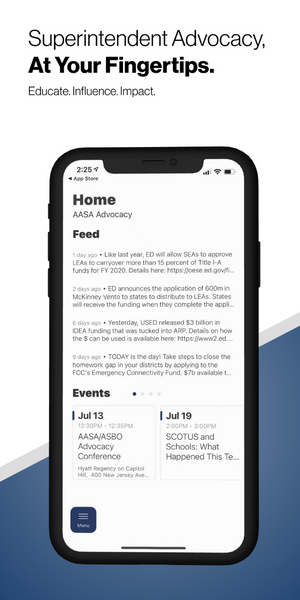


Latest Advocacy & Policy Resources
-

April 06, 2024
A Systems Approach to Limiting or Eliminating the Use Restraint and Seclusion in SchoolsType:Article Topics: Advocacy & Policy, EquityThis article highlights the prevalent use of restraint and seclusion in schools, particularly affecting students with disabilities, emphasizing recent U.S. Justice Department guidance aligning with research advocating for limited and emergency-only use of such practices, while proposing three systemic changes—implementing positive behavior intervention supports, supporting students in crisis, and involving families—to mitigate or eradicate their use. -

April 01, 2024
Advocacy and Governance Team’s Key Support RoleType:Article Topics: Advocacy & PolicyThe ins and outs of AASA’s Advocacy & Governance Department staff in furthering members’ interests. -
March 21, 2024
PEP Talk Episode 28: Title I and You!Type:Podcast Topics: Advocacy & Policy, District & School Operations, Finance & BudgetsOn this episode of PEP Talk, Kat Sturdevant interviews Nora Gordon, professor at the McCourt School of Public Policy at Georgetown University about all things Title I; what it is, how it's funded, and who it benefits.
Receive legislative and regulatory actions direct to your inbox
Stay updated on the issues that matter most to you and understand how they could affect you, your district, your students and your community.